

Hello and welcome to the West Boldon Maths curriculum page.
Mathematics teaching and learning at West Boldon follow the key aims of the National Curriculum. We aim to ensure that all pupils become fluent in the fundamentals of mathematics and in number so that they develop a solid conceptual understanding and the ability to recall and apply knowledge rapidly and accurately.

Children at West Boldon are taught to reason mathematically by following a line of enquiry, identifying connections, and establishing relationships while using precise mathematical language. They are also taught to solve problems by applying their mathematical knowledge to a variety of routine and non-routine problems with increasing sophistication, breaking complex problems into smaller, manageable steps, and persevering to find solutions.
To support these aims, we follow Power Maths White Rose Edition, a whole-school mastery curriculum that promotes deep understanding, confidence, and enjoyment in mathematics for all learners.
Our Aims
We aim to ensure that all children will:
- Become fluent in the fundamentals of mathematics.
- Develop a deep conceptual understanding and the ability to recall and apply knowledge rapidly.
- Be able to reason and problem solve by applying mathematics to a range of increasingly complex problems.
- Develop early number skills in EYFS.
- Build upon their knowledge and understanding from Year 1 to Year 6.
- Develop resilience that enables them to reason and problem solve with confidence.
How We Achieve This
To achieve these aims, we:
- Follow the Power Maths White Rose scheme of work, a whole-school mastery curriculum that promotes continuity, progression, and deep understanding in mathematics.
- Supplement Power Maths with Mastering Number in Reception, KS1, and KS2 to strengthen fluency and confidence in number skills.
- Teach daily maths lessons which include fluency, reasoning, and problem solving.
- End each maths unit with a Teach Active lesson, which incorporates movement into learning. Research backed by Loughborough University shows that these lessons:
- Improve attainment in Maths.
- Increase enjoyment and happiness in lessons.
- Make children 33% more active.
- Ensure lessons are differentiated to provide the right level of challenge for all learners.
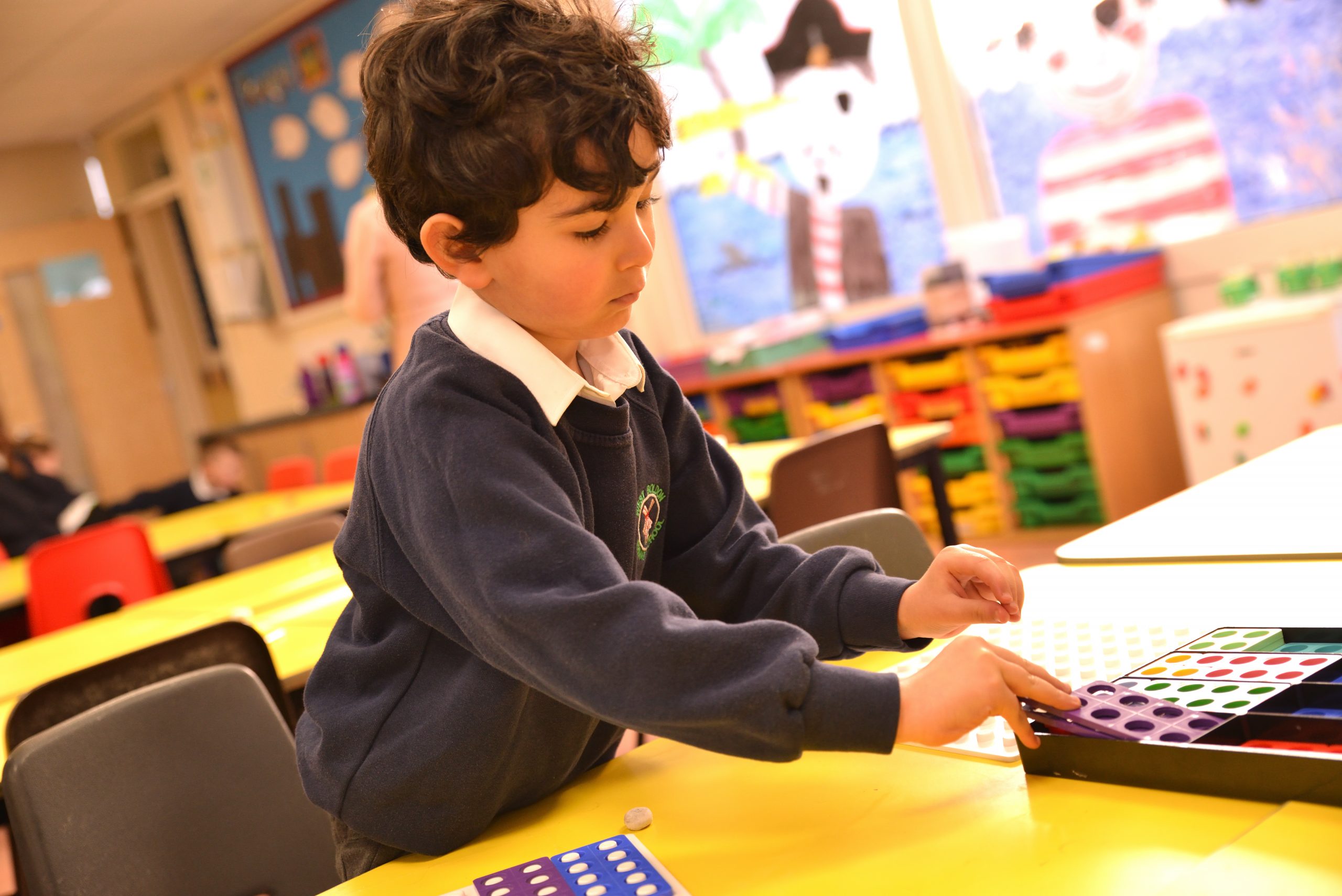
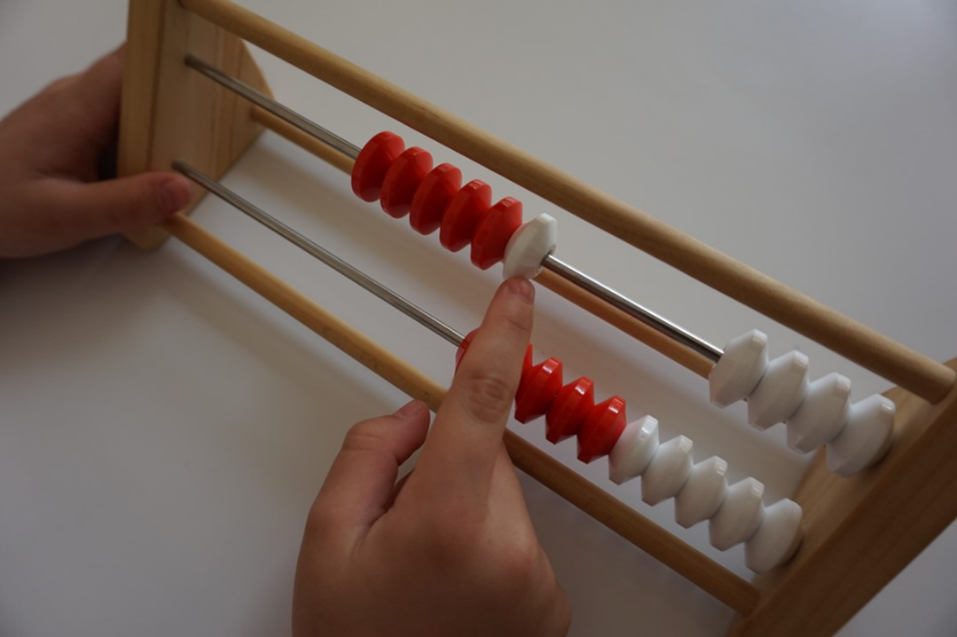
- Use concrete manipulatives and pictorial representations to support conceptual understanding and make connections across topics.
- Teach daily Core Maths and Arithmetic lessons in KS2 to embed key skills and promote fluency.
- In EYFS, we use Numberblocks to enhance early number skills and arithmetic understanding.
- Use online learning platforms such as TT Rockstars, Numbots, Maths Shed and Century to support key skills for both home learning and classroom activities.
- Assess children on a termly basis to monitor progress and inform planning.
The Impact of Our Curriculum
Through these approaches, we aim for:
- Most children to reach end-of-year expectations.
- Clear tracking of children’s progress via Sonar
- Well-planned sequences of learning that develop and refine children’s maths skills.
- Children being able to independently apply their knowledge to increasingly complex problems.
- Children reasoning with confidence, accuracy, and resilience.
- Increased enjoyment of lessons and active engagement through Teach Active lessons.

Progression in Maths
Please see below our important documents pertaining to Maths, including:
- Whole school planning and individual year group overviews.
- Key vocabulary, which is taught and built upon progressively throughout each year group.
What does a typical maths lesson look like in our school
The Power Maths teaching model:
- The curriculum is broken down into core concepts, taught in units e.g. addition and subtraction, multiplication and division, shape, statistics etc.
- Each unit is then divided into small learning steps – lessons
- Each lesson is sequenced in the same format:
Flashback 4 – Discover – Share – Think Together – Practice – Reflect




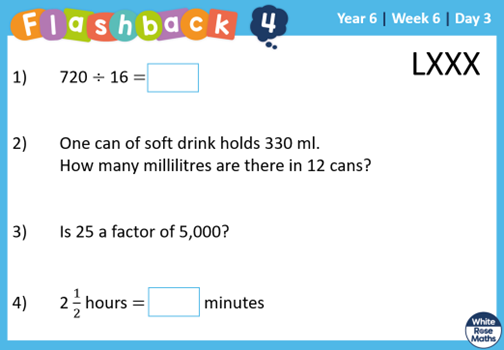
Flashback 4
- We begin each maths lesson with a Flashback 4 starter activity.
- Each Flashback 4 includes four questions, each linked to a different point in the children’s learning journey:
Something they learned yesterday
• Something they learned last week
• Something they learned two or three weeks ago
• Something they learned last term or even last year
- This regular retrieval practice strengthens memory, boosts confidence, and helps pupils build secure long-term understanding
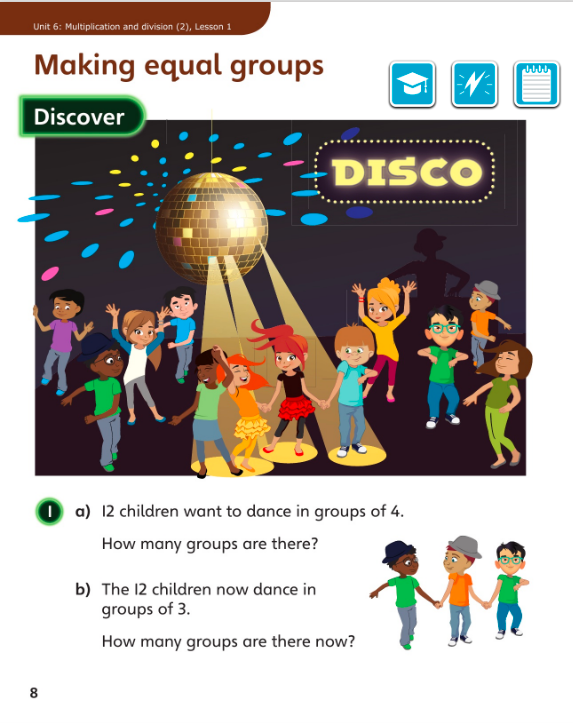
Discover
- The ‘Discover’ part of the lesson kicks off the core concept being taught in the lesson.
- It is a practical real-life problem that the children work in pairs to try to solve. It is encouraged that children use concrete objects during this part of the lesson and gives them time to play, explore and discuss possible strategies
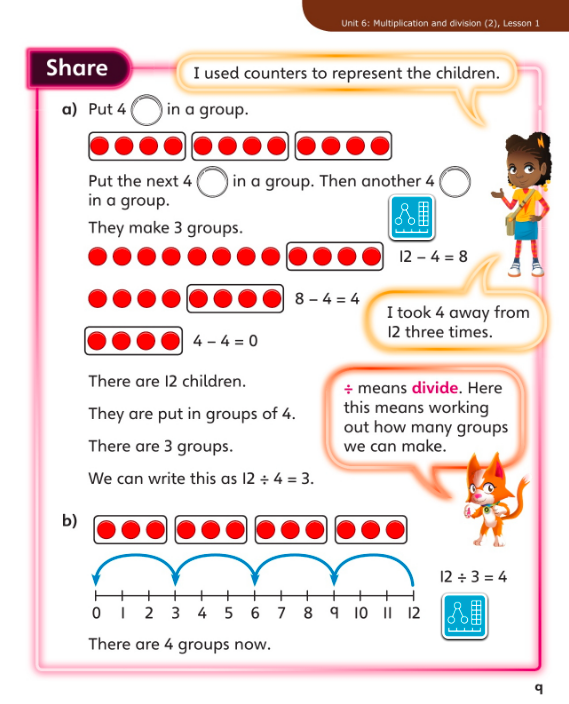
Share
- The ‘Share’ section allows the children to share and celebrate their solutions and strategies that they used to solve the problem from the ‘Discover’ section.
- The online toolkit shows how the concrete apparatus that the children used to explore the math concept, can then be explored using pictures.
- ‘Share’ is the “seeing” stage. It encourages the children to make a mental connection between the physical object they just handled and the abstract pictures, diagrams or models that represent the objects from the problem.
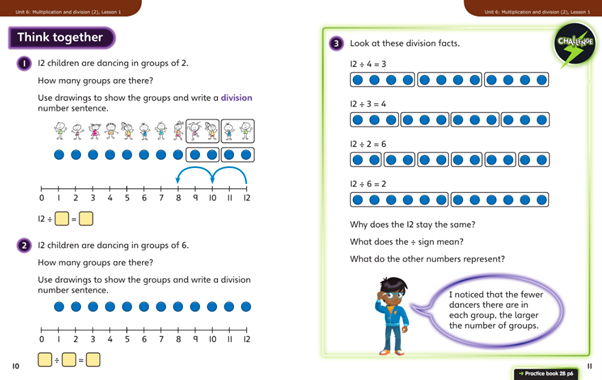
Think Together
- This section of the lesson allows children to explore new problems using the mathematical strategies they have learnt from the ‘Share’ section.
- The questions promote child independence and an ‘I can’ attitude by following an ‘I do, We do, You do approach’
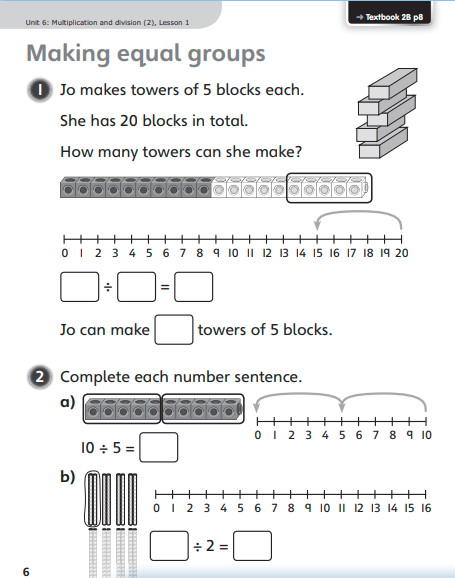
Practice
- The children have their own practice book and they work independently, following the same learning that has been explored through the ‘Discover’, ‘Share’, ‘Think Together’ sections.
- The questions in the practice book follow small steps of progression in order to deepen their learning.
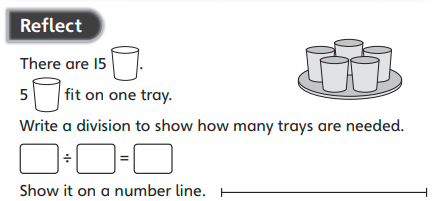
Reflect
- This section allows the teacher the opportunity to check children’s understanding and how deeply the children have understood the maths concept being taught.
Stretching and Challenging Our Children
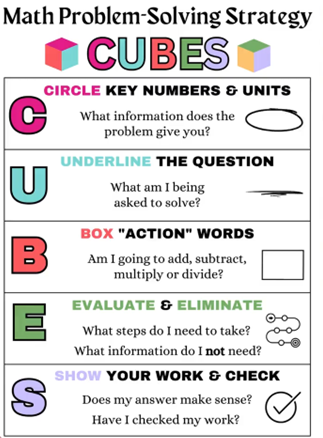
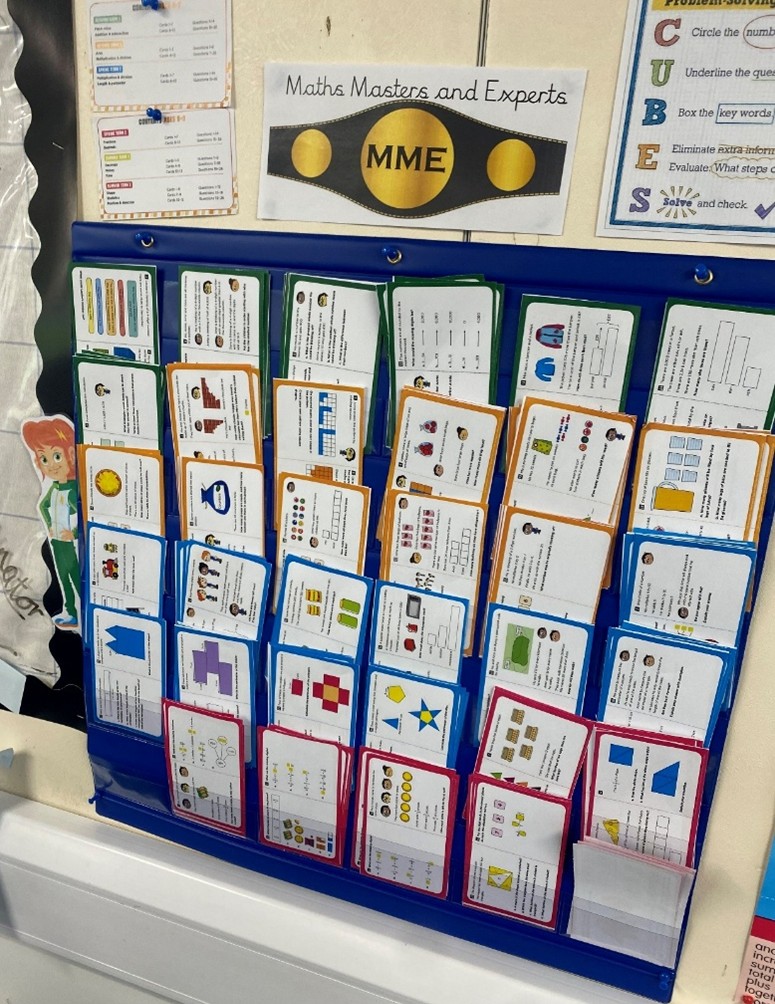
At our school, we are committed to stretching and challenging all our pupils to reach their full potential. In every lesson, children have the opportunity to access a challenge activity within their Power Maths practice books, allowing them to deepen their understanding and apply their skills in new ways. Additionally, each classroom features MME (Maths Masters and Experts) walls filled with a variety of problem-solving and reasoning questions. Pupils are encouraged to explore these activities once they have completed their practice book work, fostering independent thinking, perseverance, and a love of learning.
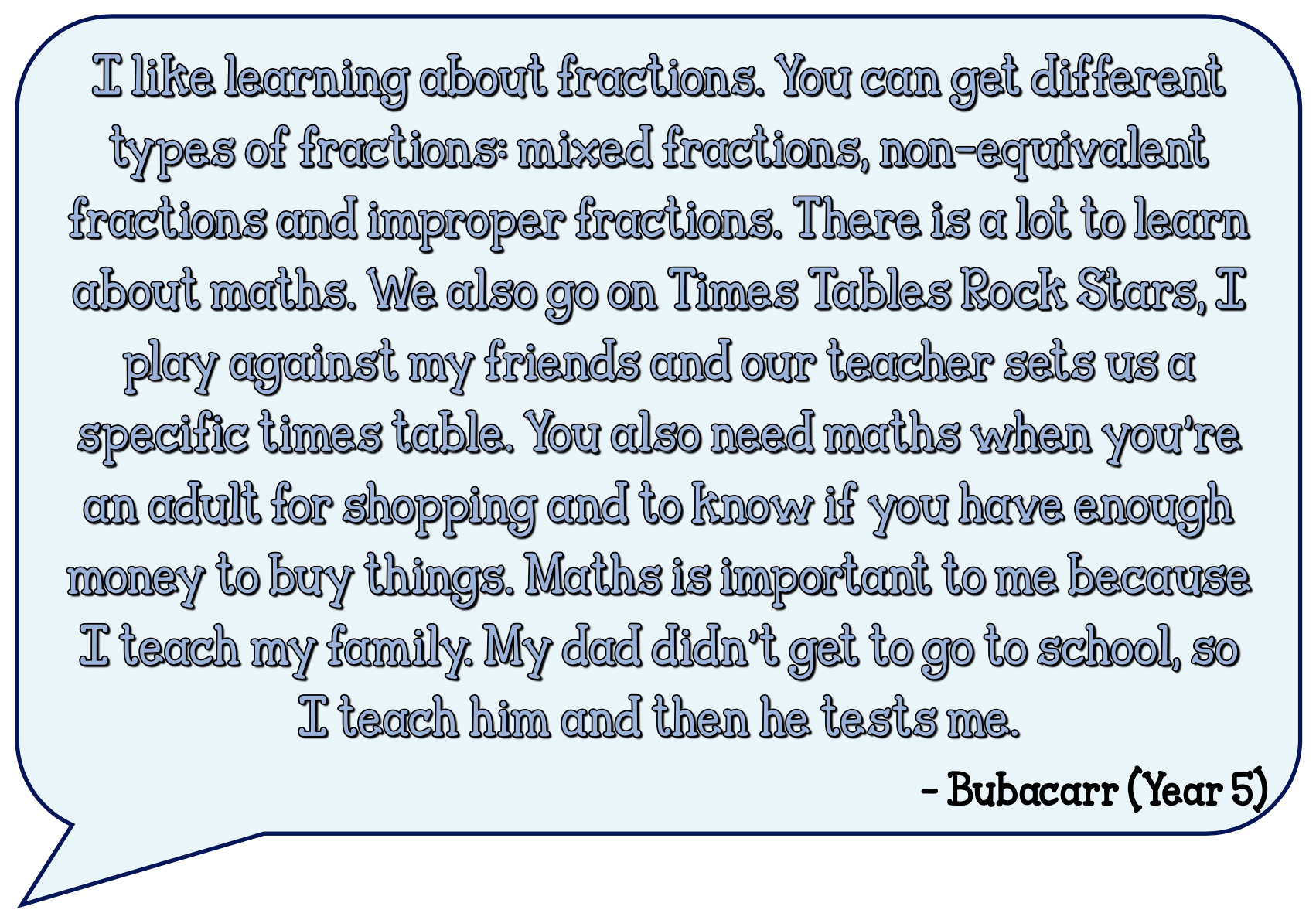
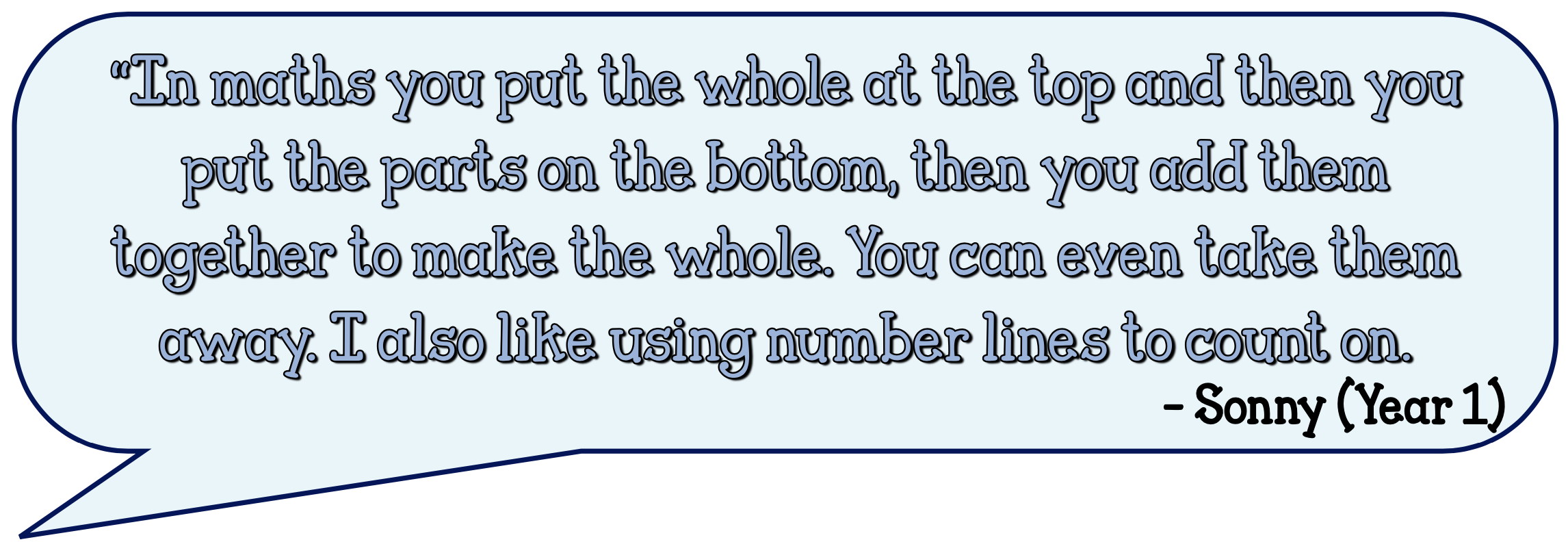
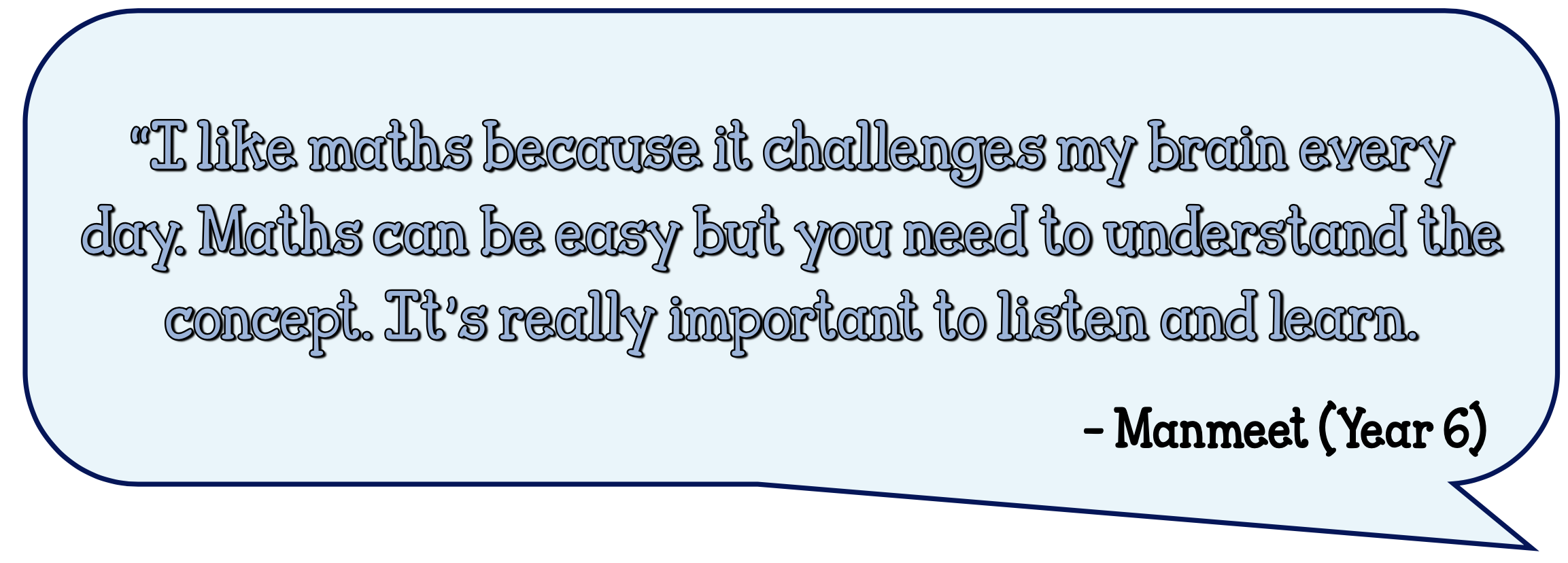
What our children say…
(Click to enlarge)
Important links…
Take a look at our Maths Curriculum documents by clicking the links below.
 Maths Rationale |
 Maths Intent, Implementation, Impact |
 Whole School Progression |

|
 Mastering Number overview Reception Year 1 Year 2 Year 3 Year 4 Year 5 |
 Skills and knowledge progression Nursery Reception Year 1 Year 2 Year 3 Year 4 Year 5 Year 6 |
 Key Vocabulary progression Year 1 Year 2 Year 3 Year 4 Year 5 Year 6 |
 Calculation Policy |
Take a look at our learning…
Click the links below to see what we’ve been learning about in Maths in each year group.
 Reception |
Year 1 |
Year 2 |
Year 3 |
Year 4 |
Year 5 |
Year 6 |
